 Does whether or not people come to Christ depend entirely on our methods? And if we could just get it right, would nearly everyone believe? I think most Christians would find these statements extreme. Yet it is easy to fall into this mindset. We can think if we just approach things the right way, it would open the floodgates to people becoming Christians. But the Scripture says no one comes to God unless God draws them (John 6:44) and God chooses who will come to Him (Ephesians 1:4). Now I am not saying we must not use diligence in our approach to reaching people for Christ (2 Timothy 2:24-26; Colossians 4:4-6; 1 Corinthians 9:19-23). Much less am I denying the obligation to proclaim the truth of the gospel (1 Peter 3:15; Matthew 28:18-20; Romans 10:14,15). But there can often be a thin line between persuasion and manipulation (1 Thessalonians 2:3-5). This is important because if only the way a person can truly come to Christ is through the power of God, then manipulation can only produce false converts (Matthew 7:21-23). So when we start to trust in our methods rather than the power of God, we end up sabotaging our efforts to genuinely bring people to Christ (1 Corinthians 2:1-5).
Wednesday, October 20, 2010
Using the Right Bait
Does whether or not people come to Christ depend entirely on our methods? And if we could just get it right, would nearly everyone believe? I think most Christians would find these statements extreme. Yet it is easy to fall into this mindset. We can think if we just approach things the right way, it would open the floodgates to people becoming Christians. But the Scripture says no one comes to God unless God draws them (John 6:44) and God chooses who will come to Him (Ephesians 1:4). Now I am not saying we must not use diligence in our approach to reaching people for Christ (2 Timothy 2:24-26; Colossians 4:4-6; 1 Corinthians 9:19-23). Much less am I denying the obligation to proclaim the truth of the gospel (1 Peter 3:15; Matthew 28:18-20; Romans 10:14,15). But there can often be a thin line between persuasion and manipulation (1 Thessalonians 2:3-5). This is important because if only the way a person can truly come to Christ is through the power of God, then manipulation can only produce false converts (Matthew 7:21-23). So when we start to trust in our methods rather than the power of God, we end up sabotaging our efforts to genuinely bring people to Christ (1 Corinthians 2:1-5).

Wednesday, October 13, 2010
The Victory Parade
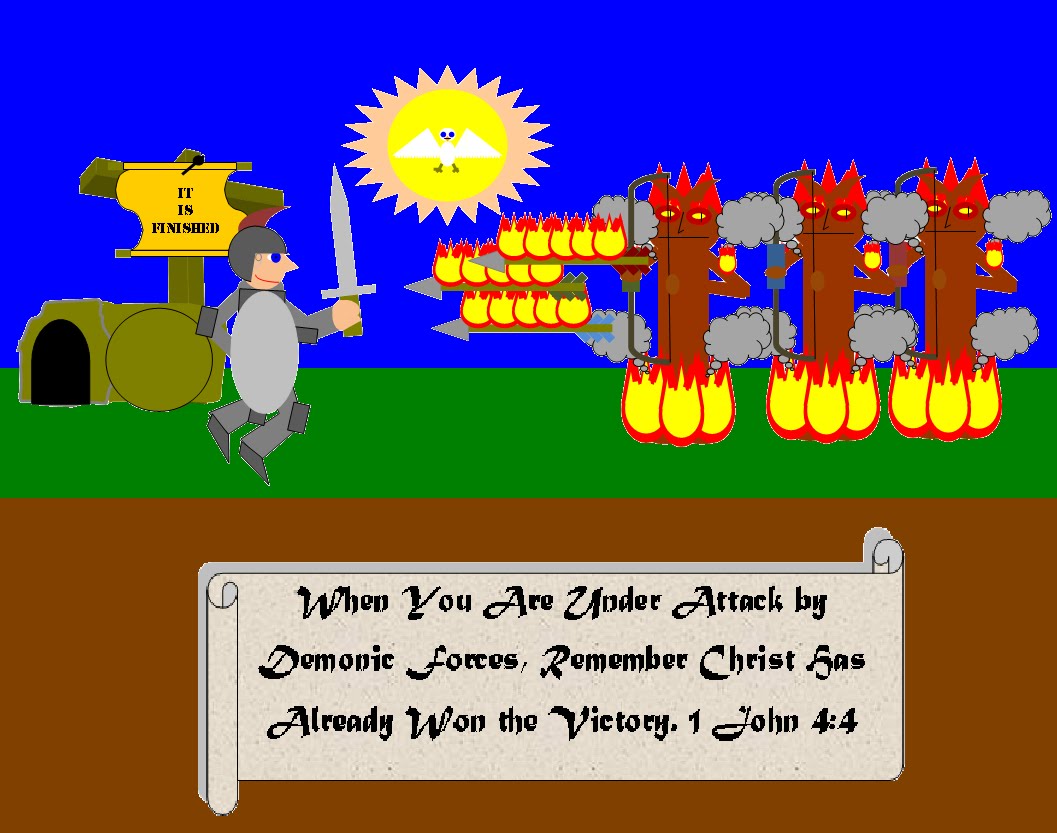 Scripture speaks of our being always led in the triumph in Christ Jesus (2 Corinthians 2:14). There is an aspect of this that it is easy to miss, given just the English translation. The word "triumph" is a reference to a specific Roman custom. When a Roman general won a great victory he was awarded a triumph. This was a procession through Rome followed by his soldiers. With him would be the best of the spoil and the most illustrious of his prisoners. He and his soldiers, who would be amply rewarded from the spoil, would be admired and cheered by the crowd as they marched through the city. In the same way, Christ has already conquered sin and death (John 16:33; 1 Corinthians 15:54-57), and we who have faith in Christ are victorious with Him (1 John 5:4). He has overcome and disarmed His enemies, leading them in the triumph (Colossians 2:15), and provides gifts to His followers (Ephesians 4:7,8). Therefore, we are already in the victory parade.
Why, then, does it sometimes not feel and look like this to us? I would submit that while we are overwhelming conquerors (Romans 8:35-37), this is from God's perspective and is in spite of the various trials mentioned in the passage. God causes all things to work together for good (Romans 8:28), but we often do not see them doing so at the present time. Nonetheless, we can trust God that, though we may not see it, we are victorious. And we should live our lives in view of the fact we have already won and are in the victory parade.
Wednesday, October 6, 2010
Smoke and Mirrors
 Scripture calls Christians to live in unity (Philippians 2:1,2) and to love one another (John 13:34,35). Yet it is not uncommon to have disagreements within congregations that lead to splits or individuals leaving or just constant struggles. Now there are cases where the issues involved are real issues of doctrinal teaching or of violations of Christian moral standards. We need to deal with these. But the majority of the time we are not faced with such a clear-cut issues.
Based on my experience I would like to make a few observations about these types of situations. There is a method that Satan and his minions use which I will call "smoke and mirrors." While I have seen this at work a number of times, I need to limit my examples to protect privacy. When I was going to seminary, my wife and I had a series of problems. As we worked it through, we found that while we did have some disagreements of substance, much of the problem was really over the meaning of words. For example, I would say something and she would take it in a different way and we would end up disagreeing over it. Also, I once had to resign from the worship team over being "too charismatic." There may have been some real issues involved, but I suspect that much of the issue was over the connotations of the phrase "too charismatic." And the ironic thing is I doubt if anyone involved could have given a clear definition of what that meant.
How then do we avoid this type of thing? It helps to realize that such problems exist, that we are sinful people (1 John 1:8-10) in an imperfect world and it effects our judgment. It also helps to remember that other Christians are imperfect and won't always meet our expectations. And ultimately, we must not be concerned just with our own interests but consider the interests of others (Philippians 2:3-11). This is complicated by the fact we can sometimes confuse our interests with something that looks noble (my ministry, the fate of my church) and act on them under this disguise. Now I am not here trying to excuse clear-cut doctrinal or moral error. But I am suggesting that on the margins there is considerable room for misunderstanding.
It does not help that the present divided state of the church aids this. I can say, "If this church does not do what I want, I will look for another one." And churches can take the attitude, "If someone does not like it here, they can go somewhere else." Now sometimes there are difficult choices that have to be made. But I cannot help thinking things would be better if people had the commitment to at least try to work things out. And they would be less likely to be taken in by smoke and mirrors.
Wednesday, September 29, 2010
Confessions of a Point Man

I used to say there were two sacrifices I made for my church. I did not play on the softball team and did not sing on the worship team. This is a story of how I did one of those things. It is not, however, a nice simple story of how I did something I thought I could not do and succeeded. It is much more convoluted than that.
My main reason for not wanting to be on the worship team is I cannot sing. Now I have found if I sing softly, I can blend in enough that hopefully no one will notice, but this hardly seems a good reason to do it up front. I do, however, have a fairly expressive worship style. (I have been told by people from a charismatic perspective that they envied my freedom of worship.) It began when the pastor said he did not want people on the worship team who could sing well, but who could worship. And I felt a nudge in the back of my mind, saying, "You can worship." Now I resisted, thinking this was a crazy idea. But it would not go away, and things I thought were conflicts vanished, so I gave in and volunteered to go on the worship team.
Strangely enough, I found people responded favorably to what I was doing. There were even those who came up afterward to thank me for it. I also seemed to be encouraging people with charismatic tendencies to be more willing to express themselves that way. I do not think it would have gone very far, maybe more people lifting up hands than had done so before, but it was a definite difference.
Things seemed to be going well until some people began complaining I was "too charismatic". (I was never able to determine exactly what this meant; the closest I came to defining the problem was "kneeling and dancing".) But if I was encouraging people to be charismatic and the leadership did not want to go there, we had a problem. Therefore, after failing to resolve the problem, I followed the leading of God and resigned from the worship team.
Now I do believe God led me onto the worship team. (It was certainly contrary to my normal way of thinking.) But I am convinced that I was led to do what I did in order to point out the potential conflict in the congregation over things charismatic before it came to a head in a more destructive way. I was the point man. In the military, the point man is the one who goes out in front of the column to act as lookout. He is also the one most likely to get shot. If I can draw a moral from this, it is that God's will is not always simple and straightforward and does not always work out as we want it to. But we must trust Him in spite of that.
Wednesday, September 22, 2010
Leap of Faith?
 What is faith? It is one of the most variously defined words in the world. In fact, there are so many different versions of what it is that it is clear if one is correct, many others are not. More importantly, what is the Scriptural definition? First and foremost, faith is faith in God (Hebrews 11:6) and not other things (Psalms 20:7; Isaiah 42:17). Also, faith is not against reason (Scripture gives reasons to believe; see 1 Corinthians 15:1-11), but against sight (2 Corinthians 5:7, Hebrews 1:1). We need to have faith to believe God's promises even if we do not currently possess them (Romans 4:18-21). Faith is therefore not faith in faith or a leap of faith into darkness, but reliance on God, whose truth we know.
We are also promised great things through faith the size of a mustard seed (Matthew 17:20), which is a seed known for its smallness. Now certainly, the presence of faith is relevant (Matthew 13:58), but the chief word for doubting in the New Testament is a strong word "to waver". It pictures someone actually fluctuating back and forth between two opinions (James 1:6-8), not someone who has an occasional doubt pass through their head. One example of God's graciousness, even when our faith is imperfect, is Acts 12:1-19. Herod Antipas puts to death James the son of Zebedee and throws Peter into prison. The church calls together a prayer meeting to petition God for Peter's release. So God sends an angel, who rescues Peter from prison. Then Peter goes to the house where they are praying for his freedom and knocks on the door. And when the maid runs into the gathering and tells them Peter is at the door, they do not believe her. It is only when Peter, after much knocking, is let in that they recognize it is really him. I am convinced God often does things for us in spite of our imperfect faith.
I am therefore convinced that faith is not a mental exercise; it is not a state of mind we work up; it is not an indefinable experience that flies in the face of reason. It is, rather, our imperfect reliance on the promises of God, even though we do not see them now. And if we have even a spark of a real faith, God will meet us there.
Wednesday, September 15, 2010
Diagnosing Demonic Involvement
 How can we decide if there is demonic involvement in a particular situation? Some would attribute every illness and sin to demonic influence. But Scripture lists demonic involvement as only one of the things Jesus dealt with (Matthew 4:24) and gives the primary source of sin as our own desires (James 1:14,15) Others would minimize or deny it, particularly in the life of a believer. (This largely comes from the King James use of the word "possession," which has no basis in the Greek.) There is also the spiritual gift of discernment of spirits, which I believe still exists today and I claim to possess. But the problem with this gift is you need to start by deciding if the gift involved is real. I know of an individual who once thought they had the gift and later decided it was spurious. What is the correct approach?
There are lists of signs of demonic involvement. But while some items come from Scripture, most come from experience, tradition, or even Hollywood. While Scripture mentions blatantly supernatural cases (Mark 5:2-20) (and these may sometimes be faked), often the symptoms are those of normal illness (Matthew 12:22). The fact that Scripture does not give a list suggests that knowing the source of the problem may not always be necessary. We need to pray for our and other's problems no matter what source they come from (Ephesians 6:18). It is also important to have other people pray for you (James 5:14-18). If there is something that suggests there might be demonic activity, it is worthwhile to direct your prayers against such activity.
I remember a sin in my life that I could not get the victory over. I asked someone to pray for me specifically against demonic involvement. I really was not expecting much, but I thought I would try one more approach. He had trouble praying and could not get his thoughts together. I had a huge feeling of weakness come over me and could not stay standing and fell down to my knees. It did not immediately solve all my sin problem. But it was the first step to turning the situation around. I remember another case where I was driving to help out in a particular situation and I could not find the house. I stopped driving to look at the map and could not read the map; it was blurred (this was totally abnormal for the state of my vision at the time). I immediately became suspicious and prayed God would lead me to the house. My vision cleared, I read the map and drove directly there. Every case needs to be dealt with based on the factors involved. Nor should we neglect to make use of appropriate medical assistance if the problem persists. But since Scripture does not give a formula for dealing with these situations, they should be approached carefully, with prayer and trust in God.
Wednesday, September 8, 2010
God's Leading
 Does God guide us, or are we left to our own wisdom? And how do we recognize God's leading? Now God is in control of all things (Ephesians 1:11) and causes all things to work together for good to those who are called by Him (Romans 8:28). He has prepared certain good works beforehand that we should walk in them (Ephesians 2:10), and the Spirit's leading is based on our being sons of God (Romans 8:14). I would therefore conclude that God guides every genuine child of God. This is a fact and is not dependent on my feelings or on my figuring it out. Nor does the fact God leads us mean it will always be easy, but it does mean He will go through troubles with us (John 16:33)
Now sometimes God allows us to feel that He is leading us, but knowing His leading is not just based on our feelings. On the contrary, while I believe God can use our careful weighing of the facts or circumstances or feelings to lead us where He wants us to go, I do not believe we should trust in any of these. Nor do I believe we should direct our lives based purely on what makes sense to us from a human point of view. Rather, we should trust in God that He will direct us to where we should be. And in any situation we must prayerfully ask whether something is indeed God guiding us or our imagination. But we need to do so with the confidence that God is in control of our life and will direct us where we need to be. I remember walking into a church for the first Sunday and hearing the pastor say that he was not going to be in charge of the Sunday School and maybe someone who just walked in the door was the person for the job. I felt like God tapped me on the shoulder and told me I was the one. As it turned out, I was. But I still approached the situation with caution and let God bring everything together, rather than jumping in too quickly based on my feeling. But it did direct me.
Now I want to make it clear that the main thing is obedience to God's revealed will (1 Thessalonians 4:3). Though even when we do disobey He can arrange things, like He did for Jonah, to bring us back to the right path (see the book of Jonah). But my concern is for those who honestly want to obey God but are afraid if they do not have the right feeling or use the right method they will miss God's direction in their lives. Or they may come to trust in their feelings or the method rather than God. For I am convinced the reason God does not give us a formula to determine His leading is we must not come to trust the formula rather than Him.
Subscribe to:
Posts (Atom)