
Showing posts with label Leading. Show all posts
Showing posts with label Leading. Show all posts
Wednesday, September 14, 2011
Following Our Impulses

Wednesday, August 10, 2011
One Step at a Time
Wednesday, June 29, 2011
Evangelism and God's Choice

Wednesday, May 18, 2011
The Open Door

I remember cases in my own life when God caused circumstances to come together to make a point. When I had first come back to following God, I was considering chickening out and not going to a meeting I had been invited to because I felt if I was a Christian I would never have any fun. I was sitting eating in the cafeteria by my college dorm when a group of people I did not know sat down at my table. They were laughing and joking and having a good time, when I noticed one of them was wearing a large cross. I thought it was probably just a piece of jewelry, but I was encouraged to go to the meeting anyway. After the meeting the same group of people came up and said that they should have said something when they sat down at my table. I have had other such experiences, but I have also had cases where nothing seemed to come together and I had no idea where God was leading me. Circumstances are relevant, but they should not be made the final judge for determining God's will.
Wednesday, March 23, 2011
Dancing in the Dungeon

Wednesday, February 9, 2011
God Works in Mysterious Ways

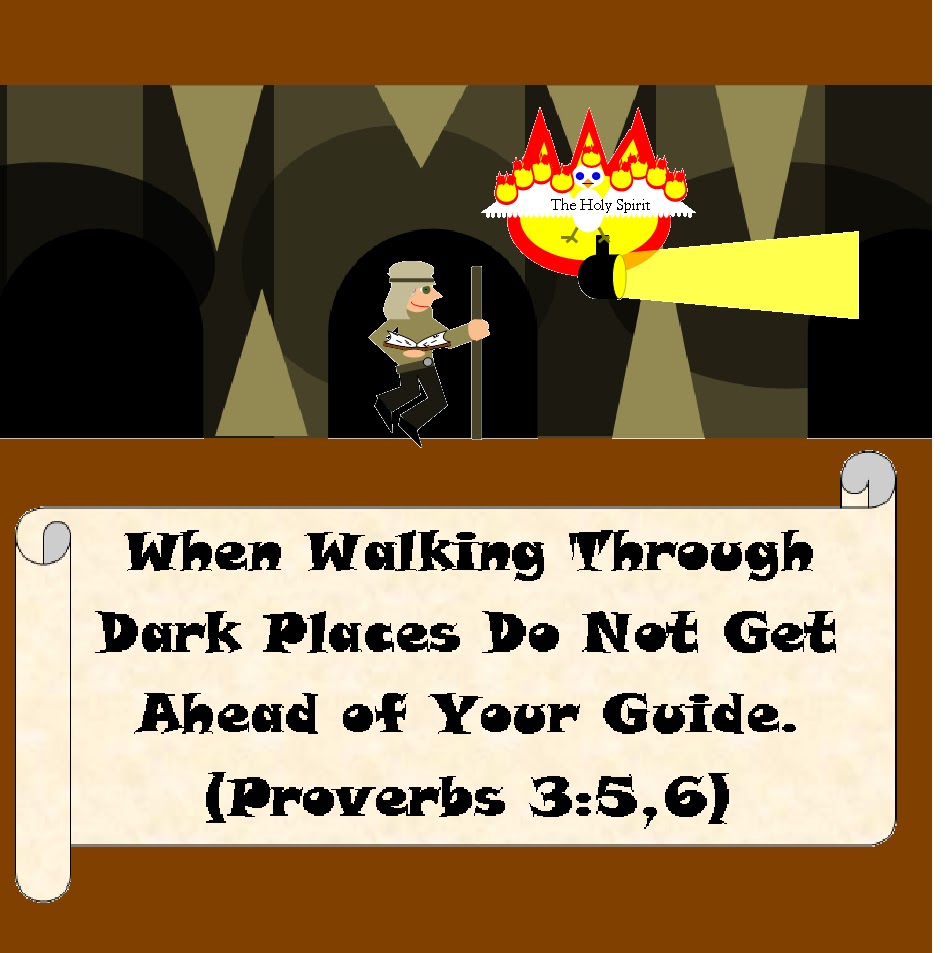
But it is at times like these that I fall back on the fact that God is in control of the world and in control of my life (Ephesians 1:11; Romans 8:28; Ephesians 2:10). Still, I do not think God ever tells us everything, because He wants us to trust in Him and not in the knowledge He gives us (Proverbs 3:5,6; Psalms 127:1,2; 1 Corinthians 3:18). If we think everything is on our own shoulders, we will falter. But if we trust in God, He will bring us through.
Wednesday, December 1, 2010
Speaking in Tongues

It can be difficult to explain something if it is not your gift. I have more then once told God if He wanted me to speak in tongues I was willing, but I wanted what He wanted. Every time, I felt He clapped my jaw shut. I therefore conclude tongues is not my gift. Holding that everyone should speak in tongues can encourage those who do not have the gift to somehow drum it up. Based on my own gift of discernment of spirits, which is, of course, itself questionable, I am convinced that tongues today can be from divine, demonic, and human sources. Whether you accept this or not, you need to be careful about regarding every instance of tongues as valid (1 Thessalonians 5:21,22). But rejecting them all out of hand also does not have any basis in Scripture. (1 Corinthians 13:8-12 clearly refers to the Second Coming.)
Scripture does give rules for speaking in tongues (1 Corinthians 14:26-33), though there may be questions of how to apply these in various circumstances. If someone says they cannot obey the rules because they cannot help themselves, I have to question whether what they are speaking in Biblical tongues. Those whose tongues I have found most convincing seem to be able to control them. Therefore, I do not buy that tongues are simply a hysterical response to pent-up emotion. There may be cases of this, but I have known several people who can speak in tongues in a perfectly calm state of mind. While I do not speak in tongues myself, I am not opposed to speaking in tongues. But I think it should be carefully tested and done in a Biblical manner.
Wednesday, September 29, 2010
Confessions of a Point Man

I used to say there were two sacrifices I made for my church. I did not play on the softball team and did not sing on the worship team. This is a story of how I did one of those things. It is not, however, a nice simple story of how I did something I thought I could not do and succeeded. It is much more convoluted than that.
My main reason for not wanting to be on the worship team is I cannot sing. Now I have found if I sing softly, I can blend in enough that hopefully no one will notice, but this hardly seems a good reason to do it up front. I do, however, have a fairly expressive worship style. (I have been told by people from a charismatic perspective that they envied my freedom of worship.) It began when the pastor said he did not want people on the worship team who could sing well, but who could worship. And I felt a nudge in the back of my mind, saying, "You can worship." Now I resisted, thinking this was a crazy idea. But it would not go away, and things I thought were conflicts vanished, so I gave in and volunteered to go on the worship team.
Strangely enough, I found people responded favorably to what I was doing. There were even those who came up afterward to thank me for it. I also seemed to be encouraging people with charismatic tendencies to be more willing to express themselves that way. I do not think it would have gone very far, maybe more people lifting up hands than had done so before, but it was a definite difference.
Things seemed to be going well until some people began complaining I was "too charismatic". (I was never able to determine exactly what this meant; the closest I came to defining the problem was "kneeling and dancing".) But if I was encouraging people to be charismatic and the leadership did not want to go there, we had a problem. Therefore, after failing to resolve the problem, I followed the leading of God and resigned from the worship team.
Now I do believe God led me onto the worship team. (It was certainly contrary to my normal way of thinking.) But I am convinced that I was led to do what I did in order to point out the potential conflict in the congregation over things charismatic before it came to a head in a more destructive way. I was the point man. In the military, the point man is the one who goes out in front of the column to act as lookout. He is also the one most likely to get shot. If I can draw a moral from this, it is that God's will is not always simple and straightforward and does not always work out as we want it to. But we must trust Him in spite of that.
Wednesday, September 8, 2010
God's Leading
 Does God guide us, or are we left to our own wisdom? And how do we recognize God's leading? Now God is in control of all things (Ephesians 1:11) and causes all things to work together for good to those who are called by Him (Romans 8:28). He has prepared certain good works beforehand that we should walk in them (Ephesians 2:10), and the Spirit's leading is based on our being sons of God (Romans 8:14). I would therefore conclude that God guides every genuine child of God. This is a fact and is not dependent on my feelings or on my figuring it out. Nor does the fact God leads us mean it will always be easy, but it does mean He will go through troubles with us (John 16:33)
Now sometimes God allows us to feel that He is leading us, but knowing His leading is not just based on our feelings. On the contrary, while I believe God can use our careful weighing of the facts or circumstances or feelings to lead us where He wants us to go, I do not believe we should trust in any of these. Nor do I believe we should direct our lives based purely on what makes sense to us from a human point of view. Rather, we should trust in God that He will direct us to where we should be. And in any situation we must prayerfully ask whether something is indeed God guiding us or our imagination. But we need to do so with the confidence that God is in control of our life and will direct us where we need to be. I remember walking into a church for the first Sunday and hearing the pastor say that he was not going to be in charge of the Sunday School and maybe someone who just walked in the door was the person for the job. I felt like God tapped me on the shoulder and told me I was the one. As it turned out, I was. But I still approached the situation with caution and let God bring everything together, rather than jumping in too quickly based on my feeling. But it did direct me.
Now I want to make it clear that the main thing is obedience to God's revealed will (1 Thessalonians 4:3). Though even when we do disobey He can arrange things, like He did for Jonah, to bring us back to the right path (see the book of Jonah). But my concern is for those who honestly want to obey God but are afraid if they do not have the right feeling or use the right method they will miss God's direction in their lives. Or they may come to trust in their feelings or the method rather than God. For I am convinced the reason God does not give us a formula to determine His leading is we must not come to trust the formula rather than Him.
Subscribe to:
Posts (Atom)