I have seen many cases of Christians trying to correct one another. And it seems to miscarry as often as not. How do we correct a fellow believer?
The fundamental issue is that our goal should be that of correction and reconciliation; we are to win our brother, not drive them away (Matthew 18:15; Galatians 6:1; Hebrews 12:12,13). We need to start with direct personal confrontation (Matthew 18:15). This does not mean to tell someone else or to try to get someone else to talk to them, but to go to them yourself. There is a reason for this. The goal is to restore the person (the word in Galatians 6:1 is used of setting a broken bone or mending a fishing net) and to restore the relationship. This may not be possible without explaining where you are coming from and perhaps instructing them in the issues. You also need to hear their defense; even if you cannot agree with it, you need to show them you have heard it. Also, if there is reconciliation they need to know you are reconciled and are not still angry with them behind their backs. None of this can be done through a third party. Now I do believe there is a place for invoking love covering a multitude of sins (1 Peter 4:8). But if it is serious enough that it must be dealt with, it should be dealt with properly.
Also, it may be necessary to bring in witnesses, either to attest to their lack of repentance (Matthew 18:16) or to establish the fact of their actions (1 Timothy 5:19). Now these witnesses need to be two or three (Numbers 35:30) and to be open and public witnesses who can testify to the actual facts of the case. In the Old Testament the witnesses were to cast the first stones (Deuteronomy 17:7) and, if false, were liable to the punishment they tried to get imposed on the accused (Deuteronomy 19:15-19). No anonymous or second-hand witnesses should be accepted.
But everything must be done with gentleness (Galatians 6:1; Hebrews 12:12,13). This does not mean we should ignore or minimize sin (1 Corinthians 5:1,2; 2 Thessalonians 3:6), but we must attempt to turn the sinner back to the right way. Even if the church is required to take the final step and exercise discipline (Matthew 18:17; 1 Corinthians 5:3-8), it should be done lovingly, with the hope for restoration (2 Thessalonians 3:14,15; 2 Corinthians 2:5-11). Confronting sin is a difficult task. It should not be undertaken lightly, but it is also dangerous to ignore, if it is necessary. We need to trust God to lead us in the right way to handle these situations. We also need to look to ourselves, that we are not drawn down into the errors of the people we are correcting (Galatians 6:1, Jude 22,23). But we must be careful to approach the situation in a Biblical manner if we hope to genuinely restore people.
Do we really believe that God is in control of our lives now and can supernaturally intervene now. What would this look like? Let us consider it.
Wednesday, November 17, 2010
Wednesday, November 10, 2010
Do You Have to Be Crazy to Be a Charismatic?
Do you have to be crazy to be a charismatic? Or does it just help? Let's look at the issues involved.
The idea that certain spiritual gifts have passed away has no solid basis in Scripture, and we are told not to forbid people to speak in tongues (1 Corinthians 14:39). (I know it is claimed that modern tongues are not real tongues, but would God command not to forbid something that is about to pass away?) Now there are rules laid down for the use of the gifts (1 Corinthians 14:26-40). However, the description given is fairly informal. We are instructed not to all talk at once and not to do things, such as speaking in tongues without an interpreter, which are not understandable. But we need to be careful of looking down on something because it is not dignified enough (2 Samuel 6:20-23). Also, the fact a gift is misused does not mean it is not legitimate. 1 Corinthians 12-14 was written to check the misuse of spiritual gifts. (Note that Paul was not shy, and if the gifts being used were largely counterfeit, we would expect him to say so.)
There is an emotional aspect to our response to God's truth. We are to rejoice (Philippians 4:4), we are to have peace (John 14:27); even faith, hope, and love have emotional components (1 Corinthians 13:13). But what is appropriate and what is overboard? Now I am hesitant to criticize other people's spiritual experiences, if they do not result in false teaching or disobedience to God's commands. But it is when people pursue experience rather then pursuing God and hold up their experience as necessary for everyone that it creates problems.
Scripture speaks of people being overwhelmed by the greatness of God (Daniel 10:8-12; Acts 9:3-9; Isaiah 6:1-5). I myself have felt the Spirit fall so powerfully I felt like I had been hit by a truck. But I have never fallen over backwards nor felt that God wanted me to. I do not feel I can discount this in all cases as a genuine spiritual experience, but I see no Scriptural basis for requiring it. I have known cases where God's truth has come home to me in such a powerful way I ended up crying or laughing . I am not at all sure this is the same as "holy laughter". As for "holy drunkenness," I do not think this is what Acts 2:13 means. Further, regarding rolling in the aisles, barking like a dog, or roaring like a lion, I do not see a Scriptural or rational basis for these.
But the basic problem is that certain spiritual gifts and emotional experiences are seen as showing a higher level of spiritual life in those who have them. This is contrary to Scripture (1 Corinthians 13:1-3; 12:28-30; Romans 12:3), which says God is at work in all His people to accomplish His purposes (2 Corinthians 3:18; Philippians 2:13; Ephesians 2:10).
Wednesday, November 3, 2010
Knowing God
What does it mean to know God? What does it mean to know any person? I like to think I know my wife. Now you could know a considerable amount about her by launching an FBI investigation and finding out facts about her. But you would not know my wife. On the other hand, if you asked me questions about my wife and I could not answer any of them, you would wonder if I really knew my wife. It is not enough just to know the facts about God; the demons do that (James 2:19). But we cannot really know God without knowing about God (Jeremiah 9:23,24). Knowing God, therefore, refers to knowledge gained in relationship. Now the only way to genuinely know God is to come through Jesus Christ (Philippians 3:8-11), who paid the price for our sins (1 Peter 2:24,25) and offers salvation based on faith in Him (Ephesians 2:8,9). But we are called from there to increase in the knowledge of Him (Colossians 1:10). This involves an increase in the factual knowledge of God in the context of relationship and leads to, not just knowledge, but obedience (1 John 4:6,7). It is this kind of knowledge, both factual and experiential, that we are to grow in.
Wednesday, October 27, 2010
Witchcraft
What is a witch? Are we to accept the idea of an old crone with a broomstick and a black cat familiar? Or should we look at a follower of the modern practice of Wicca? What does the Bible mean by a witch?There are various things addressed in Scripture that fall into this category. There is the practice of divination, attempting to determine the future by various means (Acts 16:16-19; Ezekiel 21:21-23), of casting spells (Acts 19:19; Isaiah 47:8-15), of performing wonders by one's own power (Exodus 7:11; Acts 8:9-11), or of being involved in communicating with the dead (1 Samuel 28:3-25; Isaiah 8:19). The underlying principle is the serious practice of magic (as opposed to the stage magician).
Scripturally, God is the only legitimate source of supernatural help. And He cannot be manipulated, only asked. From the Christian viewpoint the main issue is not good intentions versus bad intentions (white versus black magic), but taking to ourselves a power that belongs solely to God. Nor is the issue explicitly worshiping Satan. While I am sure Satan is flattered to be directly worshiped, in the final analysis he does not care who you worship so long as it is not God. While much of it is charlatanism, I do believe Satan and his minions can supply the supernatural power behind serious magic. (Acts 16:16-19 suggests this.) But this is not dependent on the practitioner's consciously following Satan. I know in my youth I dabbled in such things, and it at least seemed to work for me, though only on a small scale. But whether or not it works, it is wrong.
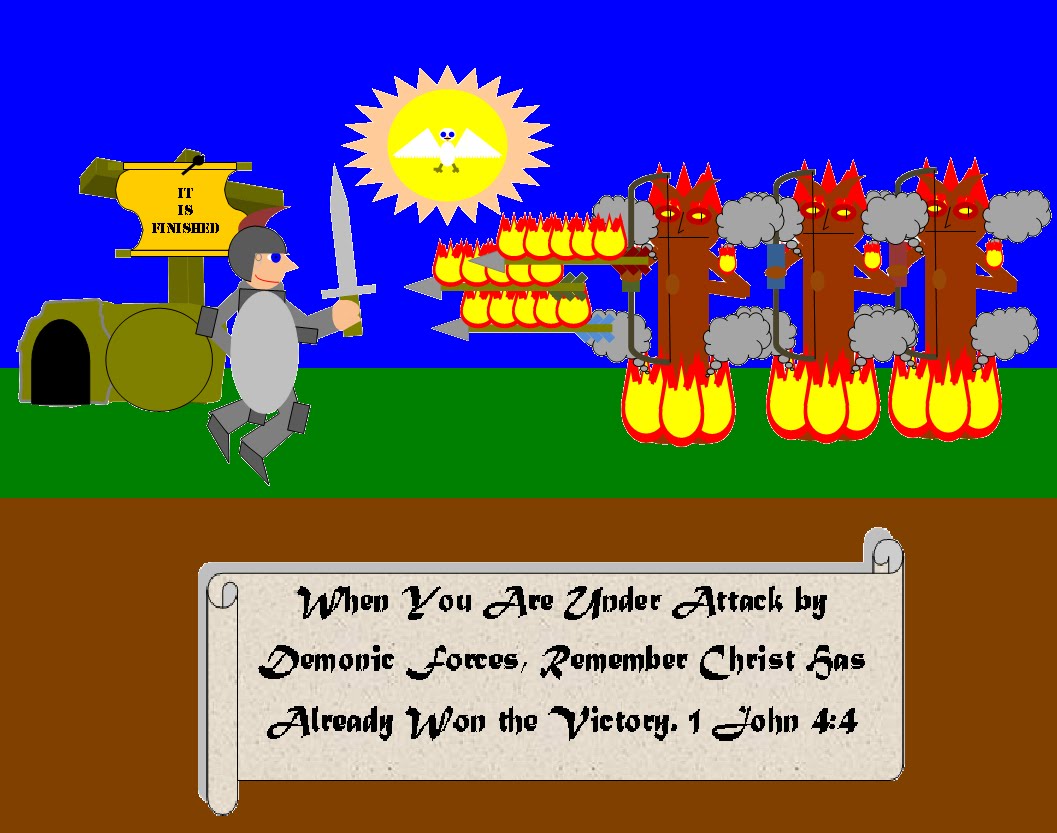
How, then, is the Christian respond to such things? First, we should avoid the use of all such things. I have known Christians to make excuses for such practices. It is also possible to approach spiritual gifts from an attitude of witchcraft, where we start to see them as our personal power rather then depending on God. But we can also become unnecessarily paranoid of witchcraft and everything associated with it. We need to remember that God is victorious over Satan and can protect us (1 John 4:4; Colossians 2:15). Therefore, we should avoid panicking at every mention of witchcraft or reading it in when it is not there. Witchcraft is wrong, but it is no more wrong than many other things our society takes for granted. We should not condone it, but we should face it boldly through faith in Christ.
Wednesday, October 20, 2010
Using the Right Bait
Does whether or not people come to Christ depend entirely on our methods? And if we could just get it right, would nearly everyone believe? I think most Christians would find these statements extreme. Yet it is easy to fall into this mindset. We can think if we just approach things the right way, it would open the floodgates to people becoming Christians. But the Scripture says no one comes to God unless God draws them (John 6:44) and God chooses who will come to Him (Ephesians 1:4). Now I am not saying we must not use diligence in our approach to reaching people for Christ (2 Timothy 2:24-26; Colossians 4:4-6; 1 Corinthians 9:19-23). Much less am I denying the obligation to proclaim the truth of the gospel (1 Peter 3:15; Matthew 28:18-20; Romans 10:14,15). But there can often be a thin line between persuasion and manipulation (1 Thessalonians 2:3-5). This is important because if only the way a person can truly come to Christ is through the power of God, then manipulation can only produce false converts (Matthew 7:21-23). So when we start to trust in our methods rather than the power of God, we end up sabotaging our efforts to genuinely bring people to Christ (1 Corinthians 2:1-5).
Wednesday, October 13, 2010
The Victory Parade
Scripture speaks of our being always led in the triumph in Christ Jesus (2 Corinthians 2:14). There is an aspect of this that it is easy to miss, given just the English translation. The word "triumph" is a reference to a specific Roman custom. When a Roman general won a great victory he was awarded a triumph. This was a procession through Rome followed by his soldiers. With him would be the best of the spoil and the most illustrious of his prisoners. He and his soldiers, who would be amply rewarded from the spoil, would be admired and cheered by the crowd as they marched through the city. In the same way, Christ has already conquered sin and death (John 16:33; 1 Corinthians 15:54-57), and we who have faith in Christ are victorious with Him (1 John 5:4). He has overcome and disarmed His enemies, leading them in the triumph (Colossians 2:15), and provides gifts to His followers (Ephesians 4:7,8). Therefore, we are already in the victory parade.Why, then, does it sometimes not feel and look like this to us? I would submit that while we are overwhelming conquerors (Romans 8:35-37), this is from God's perspective and is in spite of the various trials mentioned in the passage. God causes all things to work together for good (Romans 8:28), but we often do not see them doing so at the present time. Nonetheless, we can trust God that, though we may not see it, we are victorious. And we should live our lives in view of the fact we have already won and are in the victory parade.
Wednesday, October 6, 2010
Smoke and Mirrors
Scripture calls Christians to live in unity (Philippians 2:1,2) and to love one another (John 13:34,35). Yet it is not uncommon to have disagreements within congregations that lead to splits or individuals leaving or just constant struggles. Now there are cases where the issues involved are real issues of doctrinal teaching or of violations of Christian moral standards. We need to deal with these. But the majority of the time we are not faced with such a clear-cut issues.Based on my experience I would like to make a few observations about these types of situations. There is a method that Satan and his minions use which I will call "smoke and mirrors." While I have seen this at work a number of times, I need to limit my examples to protect privacy. When I was going to seminary, my wife and I had a series of problems. As we worked it through, we found that while we did have some disagreements of substance, much of the problem was really over the meaning of words. For example, I would say something and she would take it in a different way and we would end up disagreeing over it. Also, I once had to resign from the worship team over being "too charismatic." There may have been some real issues involved, but I suspect that much of the issue was over the connotations of the phrase "too charismatic." And the ironic thing is I doubt if anyone involved could have given a clear definition of what that meant.
How then do we avoid this type of thing? It helps to realize that such problems exist, that we are sinful people (1 John 1:8-10) in an imperfect world and it effects our judgment. It also helps to remember that other Christians are imperfect and won't always meet our expectations. And ultimately, we must not be concerned just with our own interests but consider the interests of others (Philippians 2:3-11). This is complicated by the fact we can sometimes confuse our interests with something that looks noble (my ministry, the fate of my church) and act on them under this disguise. Now I am not here trying to excuse clear-cut doctrinal or moral error. But I am suggesting that on the margins there is considerable room for misunderstanding.
It does not help that the present divided state of the church aids this. I can say, "If this church does not do what I want, I will look for another one." And churches can take the attitude, "If someone does not like it here, they can go somewhere else." Now sometimes there are difficult choices that have to be made. But I cannot help thinking things would be better if people had the commitment to at least try to work things out. And they would be less likely to be taken in by smoke and mirrors.
Subscribe to:
Posts (Atom)